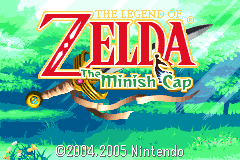
I recently got an Analog Pocket, which I intend to write about very soon, and it has reinvigorated my love for the Gameboy. Link’s Awakening is one of my favorite games and one I have an interesting history with. It was the first Zelda game I had ever played. It’s not that I was unfamiliar with the series; it just wasn’t on my mind. I was much more into platformers. One day, while walking to a friend’s house, I came across a Gameboy game lying in the gravel. It was Link’s Awakening, and the cart was in rough shape; part of the bottom was missing, and the gold contacts were exposed. But to my surprise, the game still worked! I was in love; this must have been 2002 or 2003, I was 11, and I could not put it down. Being from a family without a lot of money, I had to be very picky about what games I got, and being a PlayStation kid, I tended to gravitate towards games for that system. So, for many years, my outing with the Wind Fish was my only experience with Zelda.
However, when my Pocket finally arrived in the mail, I had planned on running through Awakening, Oracle of Ages and Seasons, and The Minish Cap having collected them over the years. Being a big of an enthusiast for all things handheld gaming. Sadly, however, the batteries in those games have long since died, except Minish Cap, as it uses flash memory. So, the decision was made for me. The Minish Cap it was. This is the third game made by Flagship and Capcom, the other two being the aforementioned Ages and Seasons. It shares a lot of DNA with the previous Gameboy games and has a decidedly classic feel. So let’s get into it.
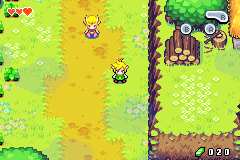
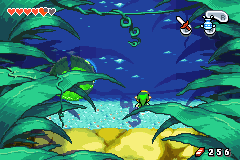
Firstly, I would like to say The Minish Cap is gorgeous. It is easily one of the best-looking GBA games I have ever seen, and it is even better on the Pocket’s high-resolution display. It melds elements from Link to the Past and Wind Waker perfectly. The characters are detailed, the enemies are varied, and the environments are a joy to look at. I don’t feel I can overstate it. You’ll travel through swamps, valleys, caves, and mountains; they all feel distinct and fun to explore. The four main dungeons you encounter are your typical Zelda affair, each based around a particular element.
You will feel right at home if you have played a traditional Zelda game in the past. The camera is in a locked top-down perspective. Due to the Gameboy Advance’s limited face buttons, you can only have two items equipped at a time, one being your sword, which you’ll want handy nearly all the time. There are some new items introduced in this game that make appearances in other games, such as the Mole Mitts and the Gust Jar. The Mits allow you to dig through certain types of terrain, and the Jar allows you to suck up debris and enemies. Link does get some new moves as well, a roll that is useful during combat. There are also several opportunities to expand his combat abilities beyond just swinging his sword. This helps keep combat engaging in ways that are missing from titles past.
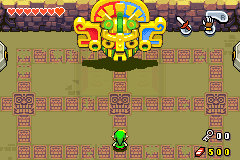
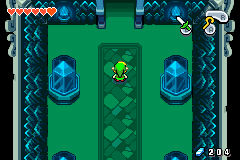
As with most Zelda titles, Link must save the princess and the kingdom of Hyrule. During a centennial celebration, the evil sorcerer Vaati appears and breaks a chest sealed many years ago in search of an ultimate power that can make him a godlike being. During these events, Zelda, Link’s childhood friend, is turned to stone. Link is then charged with his quest. In this adventure, he is accompanied by Ezlo, the titular Minsh Cap. Elzo reveals Vaati’s origins and exposes Link to the world of the Minish. Tiny beings that exist alongside the inhabitants of Hyrule, though they are only visible to children. With Ezlo’s help, Link can shrink himself down to nearly microscopic size. This is one of the major gameplay draws of the game. All of the Dungeons, with the exception of one, are entered this way. Flagship does a great job selling the fact that Link has been shrunk. By overlaying leaves, and blades of grass, you walk under broken branches, and enemies you encounter in the overworld turn into larger-than-life bosses. Exploration is handled well here, and a new system has been introduced, Kinstones. You will find these all over the place, and eventually, you are told you only process half of any given stone; the other half is held by NPCs. When you approach another character, a bubble may appear. This is your telegraph that they process a stone. When you hit the L button, you must then match their stone with one of your own to make it whole. Doing so will unlock a previously inaccessible part of the overworld or spawn a more difficult version of an enemy that nets large amounts of rupees upon defeat. I really liked this system as I was always looking forward to seeing where I could go next.
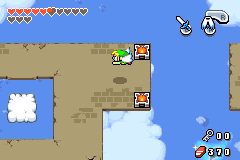
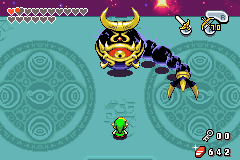
The dungeon design is solid. The four main labyrinths offer clever puzzles for you to solve with the items you acquire throughout your adventure. There is one exception for me, however, The Wind Fortress. It is the fourth main dungeon in the game and my least favorite. It involves the most backtracking, and in place of some puzzles, it features a heavier emphasis on combat. It is so long, in fact, that Ezlo sees fit to comment on it once you reach the halfway point. Saying that he can’t believe there is more but stating that there is no point in complaining about it. The final boss fight, as well, is one that I found somewhat unsatisfying, involving far too much trial and error. Previous fights give the player hints as to what you need to do in order to prevail or use mechanics that were introduced in the dungeon in which they are encountered. To make matters worse, this is a multistage encounter. If you should perish in the last stage, you are sent back before you even encounter them, dialog and all.
I loved my time with The Minish Cap. In many ways, it played to my nostalgia for Link’s Awakening. It is a visual treat and a lot of fun to actually play. I do hope that Nintendo is not completely done with this format for The Legend of Zelda; the “open air” concept in Breath of the Wild and Tears of the Kingdom is spectacular, but I don’t think that means games like this don’t have a place. In the gaming industry, as well as the community, we are always looking for the next big innovation. Leaving behind mechanics or genres in favor of something new or more convenient. But when you go back to revist or visit a game like this for the first time, I hope it shows you that there’s more to games than high polygon counts and production values. I hope people can look at something like The Minish Cap and not think it is lesser than something like Tears of the Kingdom. It is funny that a central theme in this game is the impact of small forces, as it is the small things in it that make it so great.
 The Burrow
Leave a comment